Introduction
Planning a children's birthday celebration involves managing a complex web of logistics, from coordinating entertainment to managing dietary restrictions. Among these tasks, selecting the central showpiece of the dessert table—the birthday cake—is often one of the most stressful. A recurring dilemma for parents and event planners alike is how to balance guest satisfaction with budget constraints and waste reduction. Understanding How to Pick the Right Cake Size for a Kids' Party is not merely about aesthetics; it is a practical calculation that ensures every guest receives a satisfying slice while preventing costly surpluses.
Recent event planning trends show a significant shift toward highly customized, experiential children's parties where the dessert table serves as the primary visual anchor. With custom bakery prices reflecting increased ingredient and artisanal labor costs, ordering an oversized cake can unnecessarily inflate your party budget. Conversely, running out of cake during the pivotal "happy birthday" singing moment is an embarrassing scenario that every host wants to avoid. To navigate this planning challenge successfully, you must approach cake sizing with a systematic, data-driven strategy. This comprehensive guide provides the precise calculations, dimensions, and expert tips required to make an informed decision for your next event.
Decoding Cake Servings: Party Cuts vs. Wedding Cuts
Before diving into specific cake dimensions, it is essential to understand how professional bakers calculate serving sizes. The baking industry generally relies on two standard serving measurements: "wedding cuts" and "party cuts." Understanding this distinction is the foundation of mastering How to Pick the Right Cake Size for a Kids' Party.
The Anatomy of a Wedding Cut
A standard wedding portion is traditionally calculated as a 1-inch wide by 2-inches deep slice, standing approximately 4 inches tall. This size is designed for multi-course events where the cake is served as a light, sweet finale alongside other gourmet desserts. Because these slices are quite slim, using wedding cut metrics for a high-energy children's party will almost certainly leave your guests feeling unsatisfied, particularly the adults in attendance.
The Anatomy of a Party Cut
For casual gatherings, school events, and children's birthday parties, bakeries utilize the "party cut" standard. A classic party slice measures 1.5 inches wide by 2 inches deep, standing 4 to 6 inches tall. This larger portion is robust enough to satisfy both sugar-craving kids and chaperoning parents. When consulting with a professional custom baker, always clarify that you are calculating your guest count based on generous party cuts rather than wedding portions to avoid under-ordering.
Understanding the "Kid Factor" in Portion Control
While adult guests will comfortably eat a standard party cut, children's consumption habits vary wildly based on age. Toddlers (ages 1 to 3) rarely finish a full slice of cake, often consuming only a few bites of frosting and leaving the sponge untouched. For this demographic, a "half-slice" or mini-cupcake is often more than sufficient. Conversely, older children (ages 8 to 12) and teenagers will easily consume full party-sized portions, and some may even request seconds. Adjusting your portion estimates based on the average age of the young guests is an excellent way to refine your final order.
The Definitive Kids' Party Cake Sizing Guide
To help you visualize your options, let us break down the most common cake shapes and dimensions, translating their physical sizes into reliable party servings. The following guidelines assume standard multi-layered cakes (typically two to three layers of sponge with filling, standing roughly 4 to 5 inches tall).
Round Cakes
Round cakes are the traditional choice for birthday celebrations, offering a classic silhouette that showcases custom icing designs, piping work, and themed toppers beautifully.
- 6-Inch Round Cake: This intimate size yields approximately 8 to 10 generous party slices. It is the perfect choice for small family gatherings, milestone first birthdays (where a separate smash cake is provided), or as the top tier of a larger display.
- 8-Inch Round Cake: Highly versatile and widely popular, an 8-inch round serves 12 to 16 guests. If you are hosting a small classroom group or a close circle of friends, this size is highly efficient and easily accessible.
- 10-Inch Round Cake: Serving between 20 and 24 people, a 10-inch round is the sweet spot for medium-sized children's parties where classmates and a few parents are invited.
- 12-Inch Round Cake: For larger celebrations, a 12-inch round delivers 30 to 36 robust party portions. Note that 12-inch cakes are heavy and require a sturdy cake board and flat transport surface.
Square Cakes
Square cakes are highly favored by professional caterers because they are incredibly easy to cut into uniform, grid-like portions, minimizing waste and maximizing yield.
- 6-Inch Square Cake: Yields approximately 12 party slices. Because of the angular corners, it provides slightly more volume than its round counterpart.
- 8-Inch Square Cake: Feeds roughly 16 to 20 guests. This is an excellent option for modern, minimalist, or geometric party themes.
- 10-Inch Square Cake: Easily serves 28 to 32 people, making it highly cost-effective for larger neighborhood gatherings.
Sheet Cakes
When it comes to feeding a large crowd without breaking the bank, sheet cakes are the undisputed champions of the dessert table. Baked in shallow, rectangular pans, these cakes are easy to slice, simple to transport, and highly customizable.
- Quarter-Sheet Cake (9" x 13"): This size comfortably serves 20 to 24 guests. It is an excellent, budget-friendly alternative to a 10-inch round cake.
- Half-Sheet Cake (12" x 18"): Yielding an impressive 36 to 48 servings, the half-sheet cake is ideal for joint sibling parties, large family reunions, or entire school grade levels.
- Full-Sheet Cake (18" x 24"): Designed for massive community events, school festivals, or extravagant parties, a full-sheet cake yields 72 to 96 portions. Due to its size, ensure you have adequate refrigerator space before ordering.
Key Factors to Consider When Selecting a Cake Size
Calculating your cake size is not a simple matter of matching your guest list to a sizing chart. Several external variables can influence how much cake is actually consumed at your event. To master How to Pick the Right Cake Size for a Kids' Party, you must weigh these critical factors carefully.
Guest Demographics: Adults vs. Kids
One of the most common mistakes hosts make is calculating cake sizes based solely on the number of children invited. At younger children's parties (ages 1 to 6), parents almost always stay for the duration of the event. These adult chaperones will engage with the party, socialize, and naturally expect to enjoy a slice of cake. If you expect 15 children and 15 parents, your target serving count should be closer to 30, not 15. For older kids' parties (ages 7 and up), parents often opt for a "drop-off" style, meaning you only need to account for the kids and a few adult family members.
The Role of the "Smash Cake"
For a first birthday party, the "smash cake" has become a mandatory cultural tradition. This is a small, typically 4-inch or 6-inch single-layer cake designated entirely for the baby to touch, play with, and eat with their hands. Because this cake will be thoroughly messy and unhygienic for guests to consume, it must be excluded from your guest serving calculations. Ensure you order a separate, larger cake (or a batch of matching cupcakes) to feed your actual attendees.
Other Desserts on the Menu
Are you hosting a party with a fully stocked dessert bar, an ice cream station, a candy buffet, or custom iced cookies? If the birthday cake is the only sweet treat available, you should expect close to a 100% consumption rate among your guests. However, if your party features multiple dessert options, cake consumption will naturally drop by 20% to 30%. Guests, especially children, will graze across the different sweets, allowing you to opt for a slightly smaller cake size.
Cake Height and Design Complexity
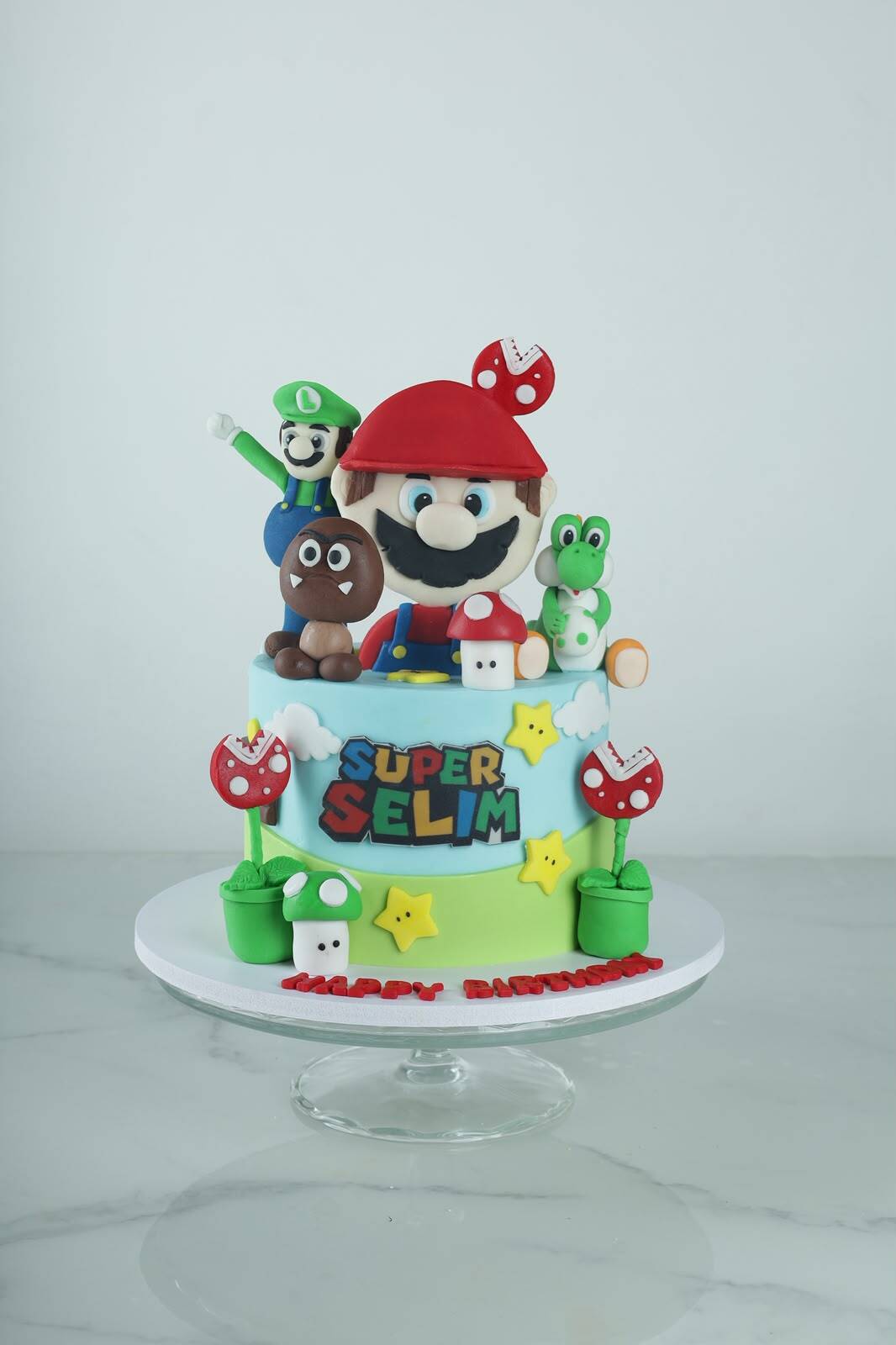
The height of your cake layers plays a significant role in portion yield. A "double-barrel" cake (a tall cake that looks like a single tier but contains a cardboard divider midway up) yields double the standard number of slices because it is cut as two separate cakes stacked on top of each other. Similarly, highly sculpted or 3D novelty cakes (such as cakes shaped like vehicles, animals, or cartoon characters) lose a portion of their edible volume during the carving process. If you choose a complex, sculpted design, consult your baker closely, as you may need a larger physical footprint to achieve your desired serving count.
A Step-by-Step Formula for Calculating Cake Size
To remove the guesswork from your party planning, follow this straightforward mathematical formula to determine the exact cake size you need to purchase:
Step 1: Determine Your Base Guest Count
Start by dividing your guest list into three categories: children under 3, children over 3, and adults. Write down these numbers clearly as RSVPs roll in.
Step 2: Apply the Consumption Multipliers
Not everyone will eat cake. Apply these realistic consumption multipliers to your guest categories to find your estimated portion target:
- Adults: Multiply the number of adults by 0.90 (Assuming 90% of adults will eat a slice).
- Children (Ages 3-12): Multiply by 1.00 (Almost every child in this range wants a slice, even if they only eat half).
- Toddlers (Under 3): Multiply by 0.50 (Two toddlers will comfortably share the equivalent of one standard slice).
Example calculation: If you have 20 adults, 15 school-aged kids, and 6 toddlers, your calculation is: (20 x 0.90) + (15 x 1.00) + (6 x 0.50) = 18 + 15 + 3 = 36 servings needed.
Step 3: Adjust for Alternative Sweets
If you are serving other major desserts (like an ice cream bar or a variety of cupcakes), reduce your total serving requirement by 15%. If the birthday cake is your sole dessert, keep the number exactly as calculated in Step 2.
Step 4: Add the "Host's Buffer"
Always add a safety buffer of 5% to 10% to your final number. This accounts for unexpected siblings who show up, last-minute RSVPs, or guests who request a second slice. Using our example of 36 servings, adding a 10% buffer gives you a final target of roughly 40 servings.
Creative Alternatives: Cupcakes, Tiered Cakes, and Hybrid Options
If you find that a single traditional round or sheet cake does not perfectly align with your vision or budget, there are several highly practical alternatives to consider when learning How to Pick the Right Cake Size for a Kids' Party.
The Cupcake Advantage
Cupcakes are an exceptional solution for children's parties. They offer built-in portion control, eliminate the need for knives, cutting boards, and messy plates at the venue, and are incredibly easy to distribute. Furthermore, cupcakes can be baked in a variety of child-friendly flavors, allowing you to accommodate picky eaters or dietary restrictions (such as offering a dozen gluten-free or vegan options alongside standard cupcakes).
The "Cutting Cake" and Cupcake Tower Hybrid
A highly popular modern compromise is the hybrid cupcake tower. This setup features a small, beautifully decorated 6-inch round "cutting cake" at the very top of a tiered display stand, surrounded by dozens of individual cupcakes below. This arrangement gives the birthday child the traditional experience of blowing out candles and allows for beautiful photography, while providing the host with the ultimate convenience of easy cupcake distribution for the guests.
Multi-Tiered Cakes for Visual Impact
If you want a grand, high-impact cake but only have a modest guest list, you do not have to buy a massive cake that will go to waste. Many custom bakers can create a multi-tiered cake using "dummy tiers." Dummy tiers are made of food-grade polystyrene foam that is iced, decorated, and textured to look exactly like real cake. By stacking a real 6-inch cake on top of an 8-inch dummy tier, you get the dramatic look of a two-tiered custom cake with the sensible portion yield of a small single tier.
Common Mistakes to Avoid When Ordering Your Cake
Even with careful planning, it is easy to make simple mistakes during the cake ordering process. Keep these common pitfalls in mind to ensure your dessert service goes smoothly:
- Underestimating Adult Attendance: Do not assume parents will politely decline cake. At a lively kid's party, adults appreciate a sweet treat and a cup of coffee. Always include them in your calculations.
- Forgetting to Consult Your Baker: Every baker uses slightly different pans and recipes. A dense, rich chocolate fudge cake might be cut into smaller slices than a light, airy sponge cake. Always ask your baker directly: "How many party-sized slices does this specific design yield?"
- Ignoring Venue Storage Limits: Large sheet cakes and tall multi-tiered cakes require significant refrigeration space. If your party is at an outdoor park, a play gym, or an indoor trampoline venue, check if they have a refrigerator large enough to hold your cake before placing your order.
- Cutting the Cake Incorrectly: Even the perfect-sized cake will run short if it is sliced inefficiently. Avoid cutting large wedge shapes from a big round cake. Instead, use the "grid method" or "caterer's cut" (cutting the cake into parallel columns, then slicing across to create neat rectangular blocks) to maximize your yield.
Key Takeaways
- Prioritize Party Cuts: Always calculate your guest count using standard party slice dimensions (1.5" x 2" x 4") rather than smaller wedding portions.
- Include Chaperones: Don't forget to account for parents and adult family members in your final serving calculations, especially for younger kids' parties.
- Assess the Dessert Landscape: Reduce your cake size by 15% to 20% if you are offering a diverse selection of alternative treats like cookies, donuts, or candy.
- Leverage the Cupcake Hybrid: Combine a small 6-inch cutting cake with matching cupcakes for the perfect blend of visual appeal and serving convenience.
- Consult the Experts: Always verify portion yields with your specific baker, as cake density and design style will impact how easily the cake can be sliced.
Frequently Asked Questions
What size cake do I need for 20 kids and 10 adults?
For a guest list of 20 kids and 10 adults, you should aim for approximately 28 to 30 servings (accounting for the fact that some toddlers may eat less, while adults will enjoy a full slice). An 8-inch square cake or a 10-inch round cake is the ideal choice for this crowd size. Alternatively, a standard quarter-sheet cake will comfortably feed this group with a few slices left over.
Is a sheet cake cheaper than a round tiered cake?
Yes, sheet cakes are almost always significantly more cost-effective than round or custom tiered cakes. Because sheet cakes are baked in standard rectangular pans, they are faster to bake, easier for decorators to ice, and simpler to box and transport. Many parents save money by ordering a small, highly detailed custom cake for display and photos, and a matching, undecorated sheet cake kept in the kitchen to feed the majority of the guests.
Should I count the birthday child in the guest count?
Yes, always count the birthday child and their siblings in your final portion calculations. While it is easy to focus on inviting outside guests, the guest of honor and their immediate family members will definitely be eating cake, so they must be included in your base math.
How do I handle gluten-free or allergen-friendly cake requests?
Attempting to make a large, main birthday cake accommodate multiple dietary restrictions (such as gluten-free, dairy-free, and nut-free) can compromise the flavor and texture for the rest of your guests, and increases the risk of cross-contamination. The safest and most efficient strategy is to order a standard main cake, and purchase a half-dozen individually wrapped, allergen-safe cupcakes from a specialized bakery specifically for those guests with dietary restrictions.
How far in advance should I order a custom kids' party cake?
For custom themed cakes, you should ideally place your order 3 to 4 weeks in advance. High-quality custom bakers limit the number of commissions they accept per weekend to ensure quality. If you are ordering a simple, non-customized cake from a local supermarket or grocery bakery, 48 to 72 hours notice is usually sufficient.
Conclusion
Determining How to Pick the Right Cake Size for a Kids' Party is a vital skill that combines practical math with event-planning strategy. By analyzing your guest demographics, choosing the appropriate cake shape, accounting for alternative desserts, and coordinating closely with your baker, you can confidently select a cake that is beautiful, delicious, and perfectly portioned. Remember to always build in a small serving buffer to manage unexpected guests, and focus on enjoying the celebration. With these professional tips in hand, your child's birthday dessert table is sure to be an organized, stress-free success.